Hustlers University launched in 2022 as a $49/month subscription. Six months in, the pattern was obvious: subscribers were paying to watch screen recordings of "professors" who had watched other screen recordings. The cancellation rate inside the first 90 days became its own meme.
The product was rebranded to The Real World after a stretch of legal trouble and ad-account bans. Same structure today. Around 18 "campuses," each one a Discord server, each one with a "professor" claiming millions in revenue. Copywriting taught by someone whose only published copy is the Tate funnel itself. Trading taught by someone whose P&L is a vibe.
What follows are five Hustlers University alternatives we curated for buyers who want the same skills without the subscription churn — real teachers, verifiable work, one-time purchase, lifetime access. All five courses are sold through Learzo.
What we deliberately left out
Free YouTube. It's fine. The reader has already tried that — it's the reason they're considering paying for something structured.
Subscription services like MasterClass and Coursera. Same core problem as Hustlers University: the buyer rents access and loses it the moment they stop paying. The economics favor the platform, not the learner. We don't sell subscriptions.
$7 ebooks that funnel into $997 then $9,997 masterminds. A handful of these are genuinely useful. Most are extraction funnels designed around upsell pressure, not skill transfer.
The five courses below have track records that can be independently verified. The instructors' public work checks out. They don't hide behind affiliate funnels.
Tony Robbins, Business Mastery
For buyers who wanted Hustlers University's "Business Mastery" campus actually delivered on, this is the original.
Tony Robbins Business Mastery is taught by a consultant who has personally advised the founders of Salesforce, Airbnb, and a list of names buyers will recognize. The original program runs as a 5-day live event plus pre-work plus recorded materials. Learzo sells the recorded version.
The price is steep — thousands. Most "alternatives" lists hide this fact behind affiliate copy. We won't.
The framework covers the 7 forces of business mastery: identifying the highest-profit customer, constructing offers that convert, anchoring and price psychology, financial dashboards readable without a CFO. The framework is dense. Robbins's delivery has 40 years of seminar energy in it, which is not for everyone.
Tate sold the dream on screenshots of a Bugatti and chess-with-cigars videos — fine entertainment, strange basis for business advice. Robbins teaches the founders of companies the reader has heard of and used. Different category of teacher.
This course is wrong for buyers below $100K in revenue. The framework feels abstract without a real bottleneck to apply it against. The cheaper courses below are better starting points.
Joanna Wiebe, Copy School
Hustlers University's copywriting campus was arguably its least bad track. Copywriting is verifiable — a portfolio can be judged in 30 seconds. Most HU "professors" had thin portfolios. Wiebe doesn't.
Joanna Wiebe's Copy School is the real version of what HU was selling. She founded Copyhackers in 2011 — where she coined the term "conversion copywriter" — and has done rewrites for Wistia, Beachbody, and Tesco. Her sales-page formulas have been screenshotted and re-taught by a thousand smaller copywriters since.
The curriculum is heavy. 60+ hours of video plus practice work, broken into seven separate "schools" inside the platform — sales pages, emails, ads, headlines, voice-of-customer research, freelance pricing, and conversion optimization. The freelance pricing module alone is worth the price for buyers planning to freelance.
The price is the main hesitation point. This is the most expensive course on the list. The math works fast for buyers serious about making copywriting their income — a single $3K freelance retainer covers it.
Graduates leave with a portfolio of work, not a Discord chat history.
This isn't "learn copy in 30 days." It's a craft. Year 1 is harder than year 3. Anyone selling "passive income copywriter" is lying.

Patrick Nill, TTT Mentorship
Trading was where Hustlers University disappointed almost everyone. The crypto and stocks campuses cycled through "professors" with unverified P&L. A 2023 audit of five of them found only two with publicly traceable accounts — both down on the year. The pattern repeats across every subscription-style trading community.
Patrick Nill's TTT Mentorship is the opposite model. Nill posts his trades publicly with screenshots, before they close, on a delay so subscribers can't front-run him. The curriculum teaches volume profile and market profile — the academic framework behind price action, not the pattern-trading TikTok bait.
Students learn how to read market structure. What "value" means in an auction context. Why most retail traders lose (spoiler: they trade patterns instead of the thing underneath the patterns). How to set up a journal. How to pick a broker. How to size positions.
For buyers who have tried day trading and lost money, this is the starting-over course. For buyers who haven't tried it, it's also the starting course. Nill teaches fundamentals, not shortcuts.
The hard part isn't the curriculum. It's the 6+ months of demo trading before going live. Almost everyone skips ahead, loses money, and blames the course. Nill is blunt about this in the first week.
Russell Brunson, Course Secrets
Hustlers University's "client acquisition" track was a diluted version of sales-funnel marketing. The original teacher of that framework is Russell Brunson, who built ClickFunnels into a billion-dollar company by teaching exactly what HU professors were repackaging.
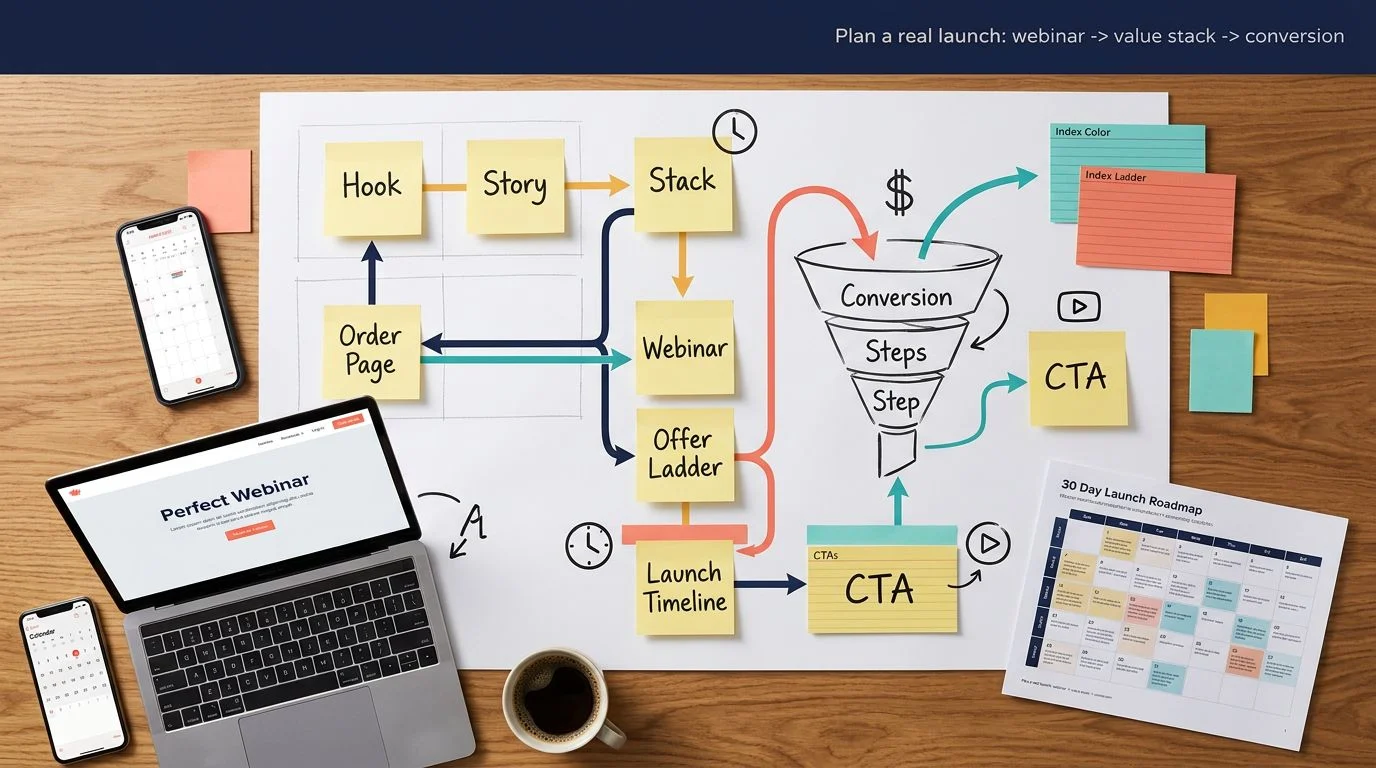
Course Secrets is the 6-week program focused on selling courses or coaching. Webinar structure. Story-selling. Value-stacked offers. The "perfect webinar" framework has generated 9-figures across his portfolio of students.
Brunson is divisive. He's loud. His books read like extended sales letters and his style triggers buyers who hate marketing-bro energy. Fine. But he can do the thing. ClickFunnels' revenue is public record. The framework works for high-ticket info products.
This course doesn't work as well for physical products or agency services. Buyers selling those should pick up his "Traffic Secrets" book for $20 instead.
The framework is load-bearing for course launches in the $20K–$100K range. We've seen students apply two or three components to a launch and credit the framework, though attribution is usually shared with an existing email list. The course doesn't replace product–market fit. It accelerates a launch that was going to work anyway.
Charlie Houpert, Charisma University
This one isn't strictly a money course. It's a foundation course. Including it on a "what to do instead of HU" list might seem off-topic. It isn't.
HU's "sales" content was weak because sales is mostly social skills, and most HU professors weren't socially skilled. They sold scripts. Scripts get prospects to "no" faster.
Charisma University is a 6-week program on the non-verbal and conversational skills that make sales work. Eye contact. Vocal modulation. Presence. Conversation flow. Around 15,000 people have taken it. Price: $97.
Every income-generating skill sits on top of being readable to other humans. Freelance pricing conversations. Networking events. Raising rates with an existing client. Leading a team without sounding like a manager. Charisma is the substrate underneath all of them.
This is the cheapest course on the list by a wide margin, and the only one under $100. That makes it a no-brainer starter for buyers who can't commit to one of the bigger programs yet but want to start building skills that compound across whatever they eventually do. For a $97 budget, this is the buy.
How to pick the right Hustlers University alternative
Match the Hustlers University alternative to the income skill the buyer originally wanted from the program.
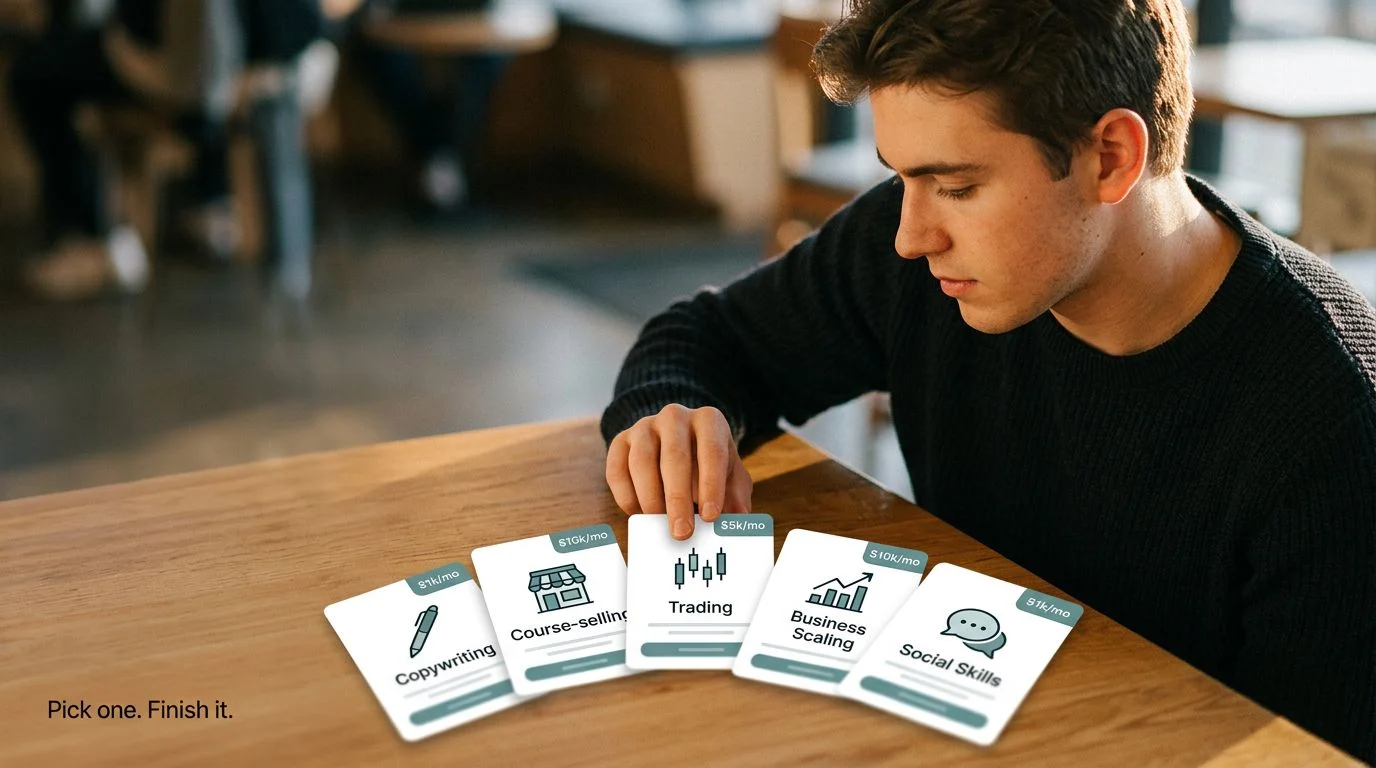
Wanted to be a copywriter? Wiebe. Wanted to trade? Nill. Wanted to sell courses or run a coaching offer? Brunson. Already running something past $100K and trying to scale? Robbins. Not sure yet? Houpert, while you figure it out.
What buyers should not do is buy all five at once. That was the HU vibe — pile on five "campuses," convince yourself you were learning, do nothing with any of it. Tab-hopping disguised as study. Pick one course. Finish it. Then pick the next.
The thing that kills 90% of online learning isn't the content. It's starting three courses and finishing zero.
Questions buyers ask about this
Is Hustlers University a scam?
No, but it's not what the marketing implies either. There is real content inside. The "professors" mostly aren't who they say they are. The affiliate-driven recruitment incentivizes existing members to sell the subscription harder than they're incentivized to help new members. A lot of energy, a lot of vibes, not much skill transfer.
Why did Tate rename it to The Real World?
The HU brand became a liability for ad accounts. The rename was a search-engine and ad-policy workaround. Same product, less searchable name.
Are these official courses?
Yes. Learzo is an authorized reseller of all five. Same content as buying direct from the instructor, plus a 14-day refund window and human customer support. Hustlers University famously does not refund.
Can the courses be taken in parallel?
Technically yes. We don't recommend it. The "How to pick" section above explains why.
What's the cheapest entry point?
Charisma University at $97.
Is access really lifetime?
Yes. Every Learzo course is one-time purchase, lifetime access. That's the whole point of the platform. The buyer owns it, can rewatch in 2030, and never gets charged again.
Why is this called a Hustlers University alternative?
Because buyers searching "Hustlers University alternative" are looking for the same income skills the HU campuses claim to teach — copywriting, trading, sales, business scaling, social skills — without the subscription model, unverified "professors," or affiliate-driven recruitment. These five courses cover the same skill territory with verifiable instructors and one-time pricing.
Course not listed here?
Learzo adds new courses every month after a curation review. Browse the full catalog for what's currently available across business, trading, copywriting, design, and personal development.

Founder
Michael Hayes is the founder of Learzo, a curated marketplace for online courses in business, marketing, trading, and personal development. He started Learzo after years of buying skills courses himself — and getting burned often enough to believe the catalog needed a curator. He writes about online education, how to judge course quality before you pay, and the unglamorous discipline of finishing what you start.
More from Michael Hayes →